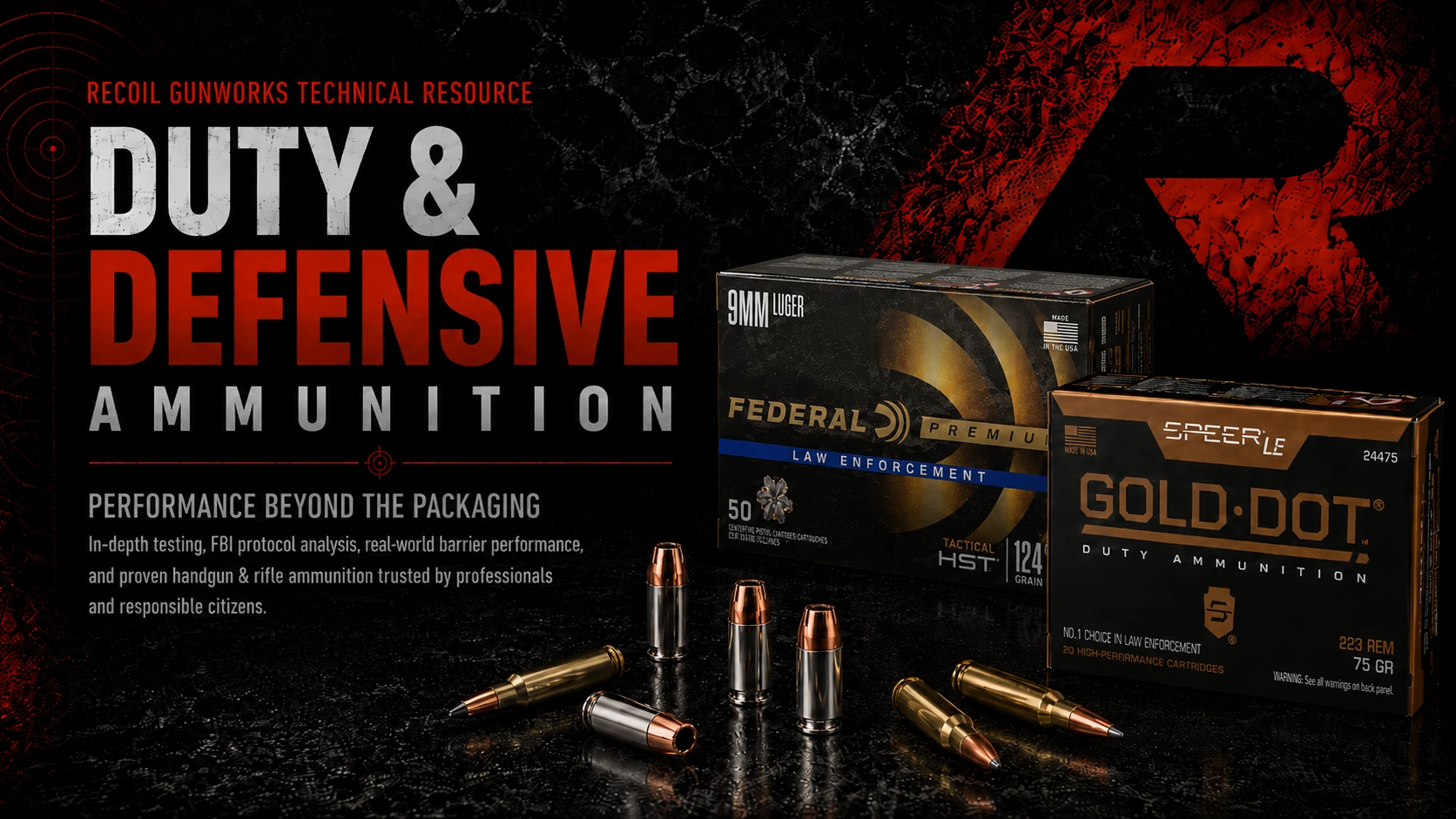
Federal HST is one of the most recognizable modern defensive handgun
ammunition families. Its design prioritizes dependable expansion,
controlled penetration and consistent terminal performance without
relying on a bonded core.
Design FocusControlled expansion with dependable penetration
The effectiveness of defensive ammunition cannot be judged by velocity,
bullet weight or expanded diameter alone. A service-grade load must
balance several competing demands: it must feed reliably, reach
sufficient depth, expand through common clothing barriers and retain
enough structural integrity to perform consistently.
Federal HST was engineered around that balance.
The hollow-point cavity and jacket geometry are designed to promote
expansion while helping the bullet maintain the penetration needed for
defensive use. Unlike traditional bonded bullets, HST uses mechanical
design rather than bonding the jacket directly to the lead core.
HST’s reputation comes from its ability to combine expansion,
penetration and reliable performance across a wide range of common
duty and concealed-carry configurations.
HST is offered in multiple calibers, bullet weights and pressure
levels. That matters because the same ammunition family can perform
differently depending on the specific cartridge, barrel length and
test conditions. A 124-grain 9mm load fired from a duty-size handgun
should not automatically be treated as identical to a heavier load or
the same cartridge fired through a compact barrel.
For that reason, ammunition selection should be based on the exact
firearm and loading—not simply the product-family name. Shooters should
verify reliable feeding, point of impact and manageable recoil in the
handgun they intend to carry.
HST is particularly well suited to users looking for a proven,
premium defensive hollow point with broad availability across popular
handgun calibers. It remains a strong reference point when comparing
other duty-oriented designs such as Speer Gold Dot, Winchester Ranger
and Hornady Critical Duty.
Explore currently available Federal HST loads, bullet weights and
caliber options at Recoil Gunworks.
Speer Gold Dot is a bonded defensive hollow-point family engineered
to maintain bullet integrity while balancing expansion, retained
weight and useful penetration through common intermediate barriers.
Design FocusBonded construction with controlled expansion
Defensive bullets are placed under significant structural stress when
they encounter clothing, glass and other intermediate materials before
reaching the intended target. A conventional jacketed hollow point can
lose part of its jacket or deform unpredictably under those conditions,
reducing retained weight and altering terminal performance.
Gold Dot addresses that problem with bonded construction.
Speer forms the jacket directly onto the lead core using its Uni-Cor
electrochemical process. The resulting bond is intended to resist
jacket-core separation while allowing the hollow-point cavity and
jacket geometry to control expansion.
Gold Dot’s defining characteristic is its bonded bullet construction,
developed to preserve structural integrity when a defensive load must
perform after encountering intermediate barriers.
Bonding does not automatically make every loading ideal for every
firearm or application. Performance still depends on the exact caliber,
bullet weight, velocity, barrel length and material encountered. The
advantage is that the bullet begins with a construction method designed
to keep the jacket and core working together during impact.
Speer offers Gold Dot handgun ammunition in multiple calibers, bullet
weights and pressure levels, including certain loads developed for
shorter barrels. This provides options for compact concealed-carry
handguns as well as full-size duty pistols, but each combination should
be evaluated individually.
Shooters should confirm reliable feeding, practical accuracy, recoil
control and point of impact in the firearm they intend to use. A load
that performs well in a service-size pistol may produce different
velocity and expansion behavior when fired through a substantially
shorter barrel.
Gold Dot remains an important comparison point for duty-oriented
defensive ammunition because its bonded design differs fundamentally
from non-bonded loads such as Federal HST. That contrast becomes
especially relevant when evaluating retained weight and performance
through intermediate barriers.
Explore currently available Speer Gold Dot loads, calibers and bullet
weights at Recoil Gunworks.
Winchester Ranger is a professional-duty ammunition family built around
reliable feeding, controlled penetration and terminal performance.
Different Ranger loads use different bullet constructions, including
traditional jacketed hollow points, bonded bullets and the distinctive
Ranger T-Series design.
Design FocusPurpose-built duty loads across multiple bullet designs
Winchester Ranger should not be treated as a single bullet design.
It is a broader professional ammunition family containing several
distinct load types, each intended to address a particular balance of
expansion, penetration, retained weight and barrier performance.
Ranger T-Series is the best-known member of the family.
Its jacket geometry is designed to control expansion and form pronounced
petals as the bullet opens. Ranger Bonded loads take a different
approach by joining the jacket and lead core to improve structural
integrity when intermediate barriers are encountered.
The Ranger name identifies a duty-ammunition family—not one universal
projectile. The exact product code and bullet construction matter when
comparing performance.
Winchester also offers Ranger One, a newer bonded duty line developed
for professional use. Winchester describes Ranger handgun ammunition as
engineered for law-enforcement applications, with product offerings
spanning multiple calibers, bullet weights and pressure levels. :contentReference[oaicite:1]{index=1}
This variety is valuable, but it also makes careful identification
essential. A Ranger T-Series load should not automatically be assumed
to behave like Ranger Bonded or Ranger One simply because all three
carry the Ranger name. Bullet design, velocity and intended application
can differ substantially.
As with every defensive load, performance depends on the specific
caliber, bullet weight, barrel length and test medium. Shooters should
verify reliable feeding, practical accuracy, recoil control and point
of impact in the exact firearm they intend to use.
Ranger remains highly relevant in comparisons with Federal HST, Speer
Gold Dot and Hornady Critical Duty because it represents several
different engineering approaches within one established duty-ammunition
family.
Explore currently available Winchester Ranger loads, bullet weights
and caliber options at Recoil Gunworks.
Hornady Critical Duty is a barrier-focused defensive handgun ammunition
family built around the FlexLock bullet. Its design emphasizes reliable
expansion, retained weight and consistent penetration after passing
through the intermediate materials used in FBI protocol testing.
Design FocusBarrier performance with controlled expansion
Defensive bullets do not always reach their target through unobstructed
tissue. Clothing, wallboard, plywood, sheet metal and automotive glass
can alter expansion, reduce velocity and place severe stress on the
bullet’s jacket and core.
Critical Duty was developed specifically with those challenges
in mind. Its FlexLock projectile combines a polymer Flex Tip
inside the hollow-point cavity with a heavy-duty jacket-to-core
InterLock band. Hornady states that this construction is intended to
reduce clogging, resist jacket-core separation and preserve terminal
performance across FBI test barriers. :contentReference[oaicite:0]{index=0}
Critical Duty is built around barrier performance first, making it a
distinct choice for full-size duty handguns and users who prioritize
consistent performance through intermediate materials.
The polymer insert helps initiate expansion after passing through heavy
clothing and other materials that can plug a conventional hollow-point
cavity. The InterLock band mechanically reinforces the relationship
between the jacket and core, while the high-antimony lead core is
intended to support controlled expansion and retained weight. :contentReference[oaicite:1]{index=1}
Critical Duty should not be confused with Hornady Critical Defense.
Critical Duty is designed around full-size handguns and FBI-style
barrier testing, while Critical Defense is generally positioned toward
personal-protection use in more compact firearms. The names are similar,
but the intended operating conditions and bullet designs are different.
As with HST, Gold Dot and Ranger, the exact loading matters. Caliber,
bullet weight, pressure level, barrel length and impact velocity all
influence penetration and expansion. Performance data from one Critical
Duty load should not automatically be applied to every other load in
the product family.
Shooters should confirm reliable feeding, practical accuracy, recoil
control and point of impact in the handgun they intend to use. Critical
Duty is especially relevant for full-size pistols and situations where
barrier performance is a central selection requirement.
Explore currently available Hornady Critical Duty loads, calibers and
bullet weights at Recoil Gunworks.
The FBI ammunition-testing protocol evaluates whether a handgun load
can deliver adequate penetration and controlled terminal performance
under repeatable conditions, both in unobstructed gelatin and after
passing through representative intermediate barriers.
Primary Evaluation Window12–18 inches of penetration in calibrated ballistic gelatin
Ballistic gelatin is used as a controlled test medium because it allows
different ammunition loads to be compared under repeatable conditions.
The gelatin does not reproduce every variable of an actual defensive
incident, but it provides a consistent way to measure penetration,
expansion, retained weight and bullet behavior.
Penetration is the first requirement.
A projectile must reach sufficient depth to remain effective after
accounting for clothing, arms, impact angle and other variables.
The FBI’s published wound-ballistics research established
12 inches as the minimum acceptable penetration depth
in gelatin. Loads are commonly evaluated within a practical
12–18 inch performance window.
Expansion remains important because it may increase the projectile’s
frontal area and help transfer energy while limiting unnecessary travel.
However, dramatic expansion is not useful when it prevents the bullet
from reaching adequate depth. The protocol therefore evaluates the
balance between penetration, expansion and structural integrity.
Under 12"Insufficient Depth
Expansion may look impressive, but inadequate penetration can prevent
the projectile from reaching the required depth.
12–18"Evaluation Window
The commonly referenced duty-ammunition range for balancing adequate
depth with controlled terminal performance.
Over 18"Additional Review
Greater depth is not automatically a failure, but expansion,
application and the complete test result require closer evaluation.
The Six Test Events
Test 01
Bare Gelatin
Establishes baseline performance without an intermediate barrier.
Penetration, expansion and retained weight are measured after impact.
Test 02
Heavy Clothing
Evaluates whether fabric layers clog or alter the hollow-point cavity
before the projectile enters the gelatin.
Test 03
Steel
Examines projectile integrity and terminal behavior after passing
through representative sheet-metal material.
Test 04
Wallboard
Measures performance after penetration through paired pieces of
gypsum wallboard representing an interior building barrier.
Test 05
Plywood
Tests the projectile after passing through a rigid wood barrier that
can deform the nose and place stress on the jacket and core.
Test 06
Auto Glass
Evaluates one of the most demanding events: angled laminated
automotive glass, which may deflect, deform or disrupt a projectile.
The protocol is a comparison system, not a guarantee.
Results can change with the exact cartridge, bullet weight, barrel length,
velocity, shot angle, test calibration and manufacturing lot. A product
family should never receive a universal rating based on one loading or one
isolated test.
Interactive Comparison
FBI Test Results
Select a test event to reorganize the comparison around that barrier.
The highlighted column shows the selected test, while the strongest
documented design matches move toward the top of the table.
Comparison MethodProtocol design, bullet construction and barrier emphasis
Select FBI Test Event
Overall Comparison
A broad comparison of each product family’s documented design,
construction and intended protocol performance.
Important:
This interactive index compares documented bullet construction and
manufacturer-stated protocol emphasis. The sorting values are editorial
comparison values, not raw FBI laboratory scores. Actual penetration,
expansion and retained-weight measurements must be tied to a specific
caliber, bullet weight, pressure level, barrel length and verified test.
Manufacturer-Published FBI Protocol Data
Pistol Test Results
Compare six widely used 9mm duty loads across the complete six-event
FBI barrier sequence. Select a test event to place the same event from
every load side by side, then use the full tables for penetration,
recovered diameter and retained-weight detail.
First line: penetrationSecond line: expanded diameterThird value: retained weight
Federal HST
Large Expansion, Load-Specific Barrier Tradeoffs
The published HST samples show very large bare-gel expansion across all
three loads. Barrier results vary by event and load: the 147-grain load
stays comparatively balanced in this dataset, while the 124-grain +P
sample shows deeper steel penetration and substantial weight loss after
auto glass. Those observations apply only to these published test values.
Speer Gold Dot
Bonded Construction and Strong Weight Retention
Gold Dot uses a bonded jacket-and-core design intended to resist
separation. In the published results shown here, the 124-, 147- and
124-grain +P loads retain nearly all original weight through most events,
with lower retained weight appearing after automotive glass.
Interpreting Penetration
12–18 Inches Is a Reference Window
The status labels in the interactive cards compare each published
penetration value with the commonly cited 12–18-inch FBI reference
window. A value outside that range is not, by itself, a complete verdict:
expansion, retained weight, shot-to-shot consistency and the intended
mission still matter.
Firearm Validation
Published Data Does Not Replace Your Test
Barrel length, lot, velocity, firearm geometry and test conditions can
change results. Confirm feeding, ignition, extraction, accuracy, point
of impact and controllability with the exact ammunition and magazines
intended for use.
Data disclosure: These are manufacturer-published individual
test results, not Recoil Gunworks laboratory tests and not multi-shot
statistical averages. Values are reproduced for technical comparison.
Winchester Ranger and Hornady Critical Duty remain covered elsewhere in
this guide, but they are not inserted into these numeric tables because a
directly comparable, complete six-event manufacturer dataset was not
available in the same public format during this revision. No missing values
have been estimated.
Intermediate Materials
Barrier Testing
Barrier testing examines what happens when a defensive projectile must
pass through another material before reaching the gelatin. Each event
places a different type of stress on the bullet and exposes different
strengths or weaknesses in its construction.
Core Principle
The barrier is not the target. It is a controlled obstacle placed
before the test medium.
Intermediate materials may clog a hollow-point cavity, damage the bullet
nose, separate the jacket from the core, reduce velocity or redirect the
projectile before it enters the gelatin. Barrier testing evaluates how
effectively the bullet manages those disruptions.
A successful barrier result is not simply the deepest result.
The complete evaluation considers penetration, expansion, retained
weight, projectile integrity and deviation from the intended path.
Different bullet designs solve these problems in different ways. Bonded
projectiles emphasize jacket-and-core integrity. Mechanically locked
designs attempt to control expansion while retaining the core. Polymer
inserts may help prevent the cavity from becoming clogged by clothing or
other material.
Evaluation Factor
Projectile Integrity
Did the jacket, core and expanded projectile remain together after
passing through the barrier?
Evaluation Factor
Controlled Expansion
Did the hollow point open predictably, remain partially expanded or
fail to expand after the barrier event?
Evaluation Factor
Adequate Penetration
Did the projectile retain enough momentum and structure to reach useful
depth after encountering the intermediate material?
What Each Barrier Reveals
Barrier 01
Heavy Clothing
Layered fabric can enter or cover the hollow-point cavity and interfere
with the normal expansion sequence.
Primary ChallengeHollow-point cavity clogging
Possible ResultDelayed, reduced or absent expansion
What To ExamineExpansion consistency and penetration depth
Barrier 02
Steel
Representative sheet metal can deform the projectile nose and place
significant stress on the relationship between the jacket and core.
Primary ChallengeImpact deformation and structural stress
Possible ResultJacket damage, core loss or altered expansion
What To ExamineRetained weight and projectile integrity
Barrier 03
Wallboard
Gypsum wallboard introduces brittle material and debris that may enter
the cavity or alter the projectile before it reaches the gelatin.
Primary ChallengeDebris intrusion and projectile disruption
Possible ResultInconsistent expansion or increased penetration
What To ExamineCavity condition and final bullet shape
Barrier 04
Plywood
A rigid wood barrier can damage the bullet nose, deform the jacket and
consume velocity before the projectile reaches the gelatin.
Primary ChallengeRigid impact and velocity loss
Possible ResultNose deformation or reduced expansion
What To ExaminePenetration, expansion and retained structure
Barrier 05
Auto Glass
Angled laminated automotive glass can deform, destabilize and redirect
a projectile while placing severe stress on the jacket and core.
Primary ChallengeDeflection, deformation and structural damage
Possible ResultTrajectory shift, core separation or expansion loss
What To ExamineDeviation, retained weight and terminal behavior
Reference Event
Bare Gelatin
Bare gelatin is not an intermediate-barrier event. It provides the
baseline against which the barrier results can be compared.
Comparison ValueShows how barriers changed projectile behavior
What To ExamineBaseline penetration, expansion and weight retention
Reading the Complete Result
No single measurement tells the complete story. A barrier-test result
should be examined as a combination of penetration depth, expansion,
retained weight, final projectile condition and path through the
gelatin. Two bullets may reach similar depths while arriving there in
very different structural conditions.
Exact caliber and bullet weight
Test-barrel length and velocity
Barrier type and impact angle
Penetration after the barrier
Recovered expansion diameter
Retained projectile weight
Barrier performance is application-dependent.
A load optimized for difficult intermediate barriers may not produce the
largest expansion in bare gelatin. Likewise, dramatic bare-gel expansion
does not establish how the same projectile will behave after steel,
plywood or automotive glass.
Defensive Rifle Loads
Rifle Defense
Defensive rifle ammunition operates at substantially higher velocity
than service-handgun ammunition. Bullet construction, impact velocity,
barrel length and barrier behavior therefore become especially
important when selecting a load for duty or defensive use.
Primary Design Requirement
Controlled terminal performance without relying on conventional
full-metal-jacket construction
Standard full-metal-jacket rifle ammunition is primarily designed for
feeding reliability and general-purpose use. Its terminal behavior may be
less predictable than ammunition built around bonded soft points,
controlled-expansion bullets or other purpose-designed projectiles.
Defensive rifle ammunition should be evaluated as a complete
cartridge system. The exact projectile, impact velocity, barrel
length, engagement distance and intermediate barrier all influence what
occurs after impact.
Shorter barrels may produce lower velocity than the published figure from
a longer test barrel. That velocity reduction can affect expansion,
penetration and the distance over which the bullet remains inside its
intended performance envelope.
Selection Factor
Bullet Construction
Bonded soft points and controlled-expansion designs are built to manage
deformation while preserving useful projectile integrity.
Selection Factor
Barrel Length
Reduced barrel length generally lowers velocity and may change the
range over which the projectile expands as intended.
Selection Factor
Barrier Requirement
A load selected for difficult intermediate barriers may emphasize
retained structure differently from a load intended for unobstructed
performance.
Featured Rifle Loads
Law-Enforcement Rifle Ammunition
Federal Tactical Bonded
Barrier-focused bonded rifle projectile
Federal Tactical Bonded rifle ammunition is designed for
law-enforcement applications where the projectile may encounter
intermediate barriers before reaching the intended test medium.
Its central engineering objective is structural
integrity. Bonded construction helps the jacket and core
remain together during impact, supporting retained weight and
controlled terminal behavior after difficult materials.
Federal also offers Tactical Bonded Tip configurations, which combine
bonded construction with a tipped projectile design. Exact product
availability and specifications depend on caliber and load number.
Bullet CategoryBonded rifle projectile
Design EmphasisIntegrity through difficult barriers
Primary ApplicationLaw-enforcement and duty use
Critical VariableExact load number and barrel length
View currently available Federal defensive and tactical rifle loads
at Recoil Gunworks.
Speer Gold Dot Rifle adapts the company’s bonded-bullet approach to
rifle cartridges. The product line uses a Gold Dot soft-point
projectile rather than a conventional handgun-style hollow point.
The jacket is bonded to the core to support expansion and
weight retention. Speer currently identifies .223 Remington
Gold Dot Rifle offerings in multiple bullet weights, including
62- and 75-grain configurations.
Bullet weight affects velocity, trajectory and terminal behavior.
The heavier 75-grain load should not be treated as interchangeable
with the 62-grain load, and firearm twist rate should also be
considered when evaluating heavier projectiles.
Bullet CategoryBonded soft point
Documented Caliber.223 Remington
Common Weights62 and 75 grains
Critical VariableVelocity, twist rate and barrel length
View currently available Speer Gold Dot rifle loads at Recoil
Gunworks.
Select the exact cartridge around the firearm and intended operating
conditions rather than choosing by brand name alone. Confirm reliable
feeding, practical accuracy and point of impact, then consider whether
the bullet remains inside its intended terminal-performance envelope
at the distances and velocities relevant to the application.
Exact caliber and chamber compatibility
Bullet construction and weight
Barrel length and expected velocity
Rifling twist rate
Expected engagement distance
Intermediate-barrier requirement
Reliable feeding and practical accuracy
Do not apply handgun assumptions directly to rifle ammunition.
Rifle projectiles operate across a wider velocity range, and small changes
in barrel length or distance may materially change impact behavior. Product
claims and test results should always be tied to the exact load and test
conditions.
Published FBI-Protocol Data
Rifle Test Results
Published manufacturer testing allows individual .223 Remington and
5.56x45mm loads to be compared across the six FBI protocol events.
The figures below are penetration depths in calibrated gelatin after
each event and must be read with the exact load, velocity and test
conditions shown by the source.
Measurement DisplayedPenetration depth in inches after each FBI test event
Load
Bare Gel
Heavy Clothing
Steel
Wallboard
Plywood
Auto Glass
Federal LE223T155-grain Tactical Bonded soft point · test velocity 2705 fpsView Product
14.75inches
15.50inches
10.75inches
14.00inches
15.00inches
11.50inches
Federal LE223T362-grain Tactical Bonded soft point · test velocity 2716 fpsView Product
Speer 24446 Gold Dot55-grain Gold Dot soft point · FBI-event test velocity 3013 fpsView Product
14.00inches
14.75inches
11.25inches
14.00inches
12.50inches
7.50inches
Penetration alone is not a complete ranking.
Expansion, retained weight, recovered-projectile condition and impact
velocity also matter. These figures are presented as documented test data,
not as a universal prediction for every barrel length or real-world event.
Defensive shotgun ammunition must be evaluated as a combination of payload, wad design, recoil level, pattern performance and firearm reliability. Unlike a single-projectile handgun or rifle load, buckshot performance also depends on how the individual pellets distribute at the intended distance.
Primary Selection RequirementPattern the exact shotgun, choke and defensive load before relying on the combination
Shotgun ammunition cannot be selected by gauge and pellet size alone. Two loads carrying the same general buckshot designation may produce substantially different patterns from the same barrel.
The shotgun, barrel, choke, wad system and ammunition form one operating system. Changing any one of those variables may alter pattern size, point of impact, recoil and reliable cycling.
Buckshot and slugs also perform different roles. Buckshot launches multiple projectiles in a pattern, while a slug functions as a single large projectile and requires confirmation of point of aim and point of impact.
Selection Factor
Pattern Performance
Pellet spread must be measured from the actual shotgun at realistic distances rather than assumed from ammunition packaging.
Selection Factor
Reliable Cycling
Semi-automatic shotguns may respond differently to reduced-recoil and full-power loads. Function testing is mandatory.
Selection Factor
Recoil Control
Lower recoil may support faster recovery and better control, but the load must still function correctly and produce acceptable patterns.
Federal Tactical buckshot includes loads designed around controlled pattern performance and law-enforcement or defensive applications. Certain configurations use Federal’s FLITECONTROL wad system.
The wad system is intended to keep the shot payload together longer after leaving the barrel. This can produce a tighter pattern than conventional buckshot, but the actual result still depends on the shotgun, barrel and distance.
Reduced-recoil configurations may improve shooter control and recovery. They must still be tested for reliable operation, especially in semi-automatic shotguns.
Load CategoryDefensive and tactical buckshot
Design EmphasisControlled pattern performance
Available TypesMultiple pellet sizes and recoil levels
Required TestPattern and function in the exact shotgun
View currently available Federal defensive shotgun ammunition at Recoil Gunworks.
Defensive buckshot, slug and specialty configurations
Winchester Defender is a defensive shotshell family containing multiple configurations rather than one universal load. Available designs may include buckshot, slug or combined-payload concepts.
The exact product number must be identified before comparing performance. Pellet count, projectile construction, recoil, velocity and intended firearm may vary across the product family.
Slug and buckshot configurations should not be evaluated as interchangeable. A buckshot load requires pattern testing, while a slug requires confirmation of accuracy and point of impact.
Product FamilyDefensive shotshell ammunition
Load TypesBuckshot, slug and specialty configurations
Primary VariableExact product and payload design
Required TestPattern, zero and firearm reliability
View currently available Winchester defensive shotgun ammunition at Recoil Gunworks.
A slug acts as a single large projectile and must be evaluated for accuracy, trajectory and point of impact.
Projectile TypeSingle projectile
Primary TestAccuracy and confirmed zero
Critical VariableSlug design, barrel and sights
Selection GoalPredictable placement and terminal behavior
Patterning Protocol
Patterning establishes the actual spread and point of impact produced by a particular shotgun and load. Fire multiple carefully aimed shots at measured distances and document the complete pellet distribution. Repeat the process whenever the ammunition, barrel or choke changes.
Use the exact shotgun intended for the load
Confirm safe firearm operation and sight alignment
Fire at clearly measured distances
Record the location of every pellet
Measure the complete pattern, not only the center cluster
Confirm point of aim versus point of impact
Repeat with multiple shells from the same load
Re-test after changing ammunition, barrel or choke
Do not assume that all buckshot patterns alike. Pellet size printed on the box does not establish the pattern produced by a particular shotgun. Likewise, birdshot should not be treated as interchangeable with purpose-built defensive buckshot or slug ammunition.
Duty Shotgun Reference
Duty Shotgun Loads
Selecting a duty shotgun load requires balancing pattern consistency,
recoil, penetration, reliable cycling and mission requirements. These
four Federal Tactical loads cover reduced-recoil buckshot, full-power
buckshot and rifled-slug applications.
The eight-pellet payload reduces the chance of a ninth-pellet flyer and is a strong option when tight, repeatable patterns and reduced recoil matter most.
Choose LE13200 When
You Want a Nine-Pellet Duty Load
LE13200 combines a traditional nine-pellet payload with reduced recoil and FLITECONTROL pattern management for broad patrol and defensive use.
Choose LE12700 When
Full-Power Performance Is Required
The higher-velocity nine-pellet load may fit shotguns that cycle most reliably with full-power ammunition or missions calling for greater velocity.
Choose LE127RS When
A Slug Is the Correct Tool
LE127RS serves a single-projectile role where accuracy, point of impact and barrier performance matter more than buckshot pattern density. Confirm zero and reliable cycling before duty use.
Pattern and zero verification are mandatory.
Buckshot must be patterned at realistic distances with the exact shotgun,
barrel and choke. Slugs must be checked for accuracy, point of impact and
reliable operation. Published specifications do not replace firearm-specific
validation.
Mission-Based Load Selection
Duty vs Carry
“Duty” and “carry” are not rigid ammunition categories. They describe
different operating priorities. The correct load is the one that proves
reliable in the actual firearm and delivers the required performance
from its barrel length, recoil level and intended mission.
Core Selection Rule
Choose the exact load for the firearm and mission—not simply the wording
printed on the box
Service & Agency Use
Duty Load Priorities
Duty selection typically places greater emphasis on consistent
performance across test events, service-size firearm reliability and
institutional validation.
01
Barrier Performance
Performance through heavy clothing, wallboard, steel, plywood and
automotive glass may be central to the mission.
02
Institutional Testing
Selection may include documented protocol testing, lot evaluation
and approval through a formal procurement process.
03
Service-Weapon Reliability
The load must cycle, feed and function consistently in the issued
pistol and duty magazines.
04
Repeatable Terminal Performance
Penetration, expansion and retained weight should remain
predictable across the required test events.
05
Qualification Control
Recoil, point of impact and training compatibility still matter,
even when barrier capability receives greater emphasis.
Concealed & Off-Duty Use
Carry Load Priorities
Carry selection typically places greater emphasis on compact-firearm
function, controllability, barrel-length performance and practical
concealment.
01
Compact-Barrel Performance
Velocity and expansion should be considered from the actual barrel
length rather than assumed from full-size test guns.
02
Reliable Feeding
The bullet profile and cartridge must function consistently in the
individual compact or subcompact pistol.
03
Controllable Recoil
Faster recovery and accurate follow-up shots may outweigh a small
difference in advertised velocity or bullet weight.
04
Flash & Blast
Short barrels can increase blast and visible flash, which may
influence practical load selection.
05
Practical Carry Compatibility
Magazine capacity, pistol size and the user’s ability to train
consistently are part of the complete system.
Mission Profile
Institutional or service use
Typical Firearm
Full-size or compact service pistol
Barrier Emphasis
Often high
Recoil Priority
Balanced with protocol performance
Barrel Sensitivity
Test issued barrel length
Validation
Agency protocol and lot testing
Same Load, Different Context
Federal HST, Speer Gold Dot and other established defensive loads may
serve in both duty and concealed-carry roles. The label does not decide
the role. Caliber, bullet weight, barrel length, recoil, reliability and
documented performance determine whether a specific load fits a specific
firearm and mission.
Important DistinctionOne product family can contain very different loads
Evaluate the exact caliber, bullet weight and product number. Do not
transfer performance claims from one configuration to another.
Selection Matrix
Use Case
Primary Role
Highest-Priority Factors
Testing Focus
Common Risk
Full-Size Duty Pistol
Duty
Barrier consistency, reliability and institutional approval
Complete protocol plus issued-weapon function
Choosing by reputation without lot or weapon validation
Compact Duty Pistol
Duty
Protocol performance from reduced barrel length
Velocity, point of impact, expansion and cycling
Assuming full-size pistol results transfer unchanged
Subcompact Carry Pistol
Carry
Reliable expansion, feeding and recoil control
Actual short barrel, magazines and realistic practice
Selecting excessive recoil that reduces practical accuracy
Vehicle-Heavy Duty Use
Duty
Automotive-glass performance and predictable deflection
Glass event, retained weight and post-barrier trajectory
Relying on bare-gel results alone
Home Defense
Context
Reliability, controllability and environment-specific concerns
Actual firearm, likely distance and user capability
Treating one test result as a complete risk assessment
Plainclothes / Off-Duty
Carry
Compact reliability, concealment and manageable recoil
Carry gun, carry magazines and chosen holster system
Using an issued load without verifying the smaller pistol
Bottom line:
Choose the exact load that proves reliable in the actual firearm and
performs appropriately from its barrel length. “Duty,” “defense” and
“personal protection” are starting labels—not substitutes for testing.
Technical Reference
Frequently Asked Questions
Defensive ammunition decisions often come down to reliability, firearm
compatibility, documented performance and realistic expectations.
These answers summarize the practical considerations covered throughout
this guide.
Use This Section
Open any question for a concise technical explanation
Choosing Defensive Ammunition
No. Price alone does not determine terminal performance. Look for
documented testing, reliable function in your firearm,
appropriate penetration and consistent expansion rather than
assuming the most expensive box is automatically the best choice.
Only when the firearm is rated for it and the additional recoil,
blast and velocity support your intended use. Higher pressure can
improve the performance of some loads, but it may also reduce
controllability or increase wear. The exact load should be tested
in the actual firearm.
Not necessarily. Bullet construction, impact velocity,
expansion, shape and retained weight may influence penetration
as much as—or more than—bullet weight alone. Compare the exact
load rather than relying on weight as a shortcut.
Often, yes. Established product families such as Federal HST and
Speer Gold Dot may serve both roles. The decision depends on the
exact caliber, bullet weight, firearm, barrel length, recoil,
reliability and mission requirements—not the product-family name
by itself.
Reliability & Firearm Compatibility
There is no universal number that guarantees reliability.
Fire enough of the exact load through the intended firearm and
magazines to evaluate feeding, extraction, ignition, slide
lock, accuracy and point of impact. Testing should be meaningful
enough to establish confidence without pretending any round
count can eliminate every possible malfunction.
Inspect carried cartridges regularly. Repeated chambering can
contribute to bullet setback or case damage, while exposure to
moisture, oils, heat and handling can affect cartridge condition.
Replace rounds showing corrosion, deformation, setback or other
visible damage.
Yes. Hollow-point bullets are engineered to operate within
velocity windows. A shorter barrel may reduce impact velocity
enough to change expansion, penetration and recoil behavior.
Results from a full-size test barrel should not automatically be
transferred to a compact or subcompact firearm.
Match recoil impulse, bullet weight and point of impact as closely
as practical. Most training can be completed with quality
practice ammunition, but periodic practice with the actual
defensive load confirms function and helps verify that the
firearm behaves as expected.
Rifle & Shotgun Loads
Bonded construction is commonly used to improve jacket-and-core
integrity and retained weight after intermediate barriers.
That can be valuable for duty applications, but “bonded” alone
does not guarantee the best performance in every event. Compare
the exact load’s documented results.
Yes. Shorter barrels typically reduce velocity, which may change
expansion, fragmentation, penetration and effective range.
Evaluate performance from a barrel length reasonably close to the
firearm that will actually use the load.
Shotgun patterns vary with the individual shotgun, barrel, choke,
distance and load. Even identical models may pattern differently.
Pattern testing shows how the selected ammunition actually
performs at realistic distances and identifies the range at which
pellet spread becomes unacceptable for the intended use.
No. Buckshot and slugs solve different problems. Buckshot places
multiple projectiles on target and must be evaluated for pattern
size. Slugs provide a single projectile with greater range and
penetration. The choice should reflect the firearm, environment,
likely distance and the user’s training.
FBI Testing & Buying Decisions
No. The FBI protocol is a standardized testing method—not a
universal ranking system. It helps compare penetration,
expansion, retained weight and barrier behavior under controlled
conditions. Mission requirements and firearm reliability still
determine whether a load is appropriate.
That range is associated with the FBI’s calibrated-gelatin
evaluation framework. It is intended to account for clothing,
intermediate tissue, shot angle and anatomical variation.
Penetration depth is important, but it should be considered with
expansion, retained weight and consistency across events.
Bare gelatin provides a useful baseline, but it does not show how
a bullet responds to heavy clothing or intermediate barriers.
A complete evaluation may also consider wallboard, steel,
plywood and automotive glass when those events are relevant to
the intended role.
First confirm that the exact load is reliable, accurate and
controllable in the intended firearm. After validation,
purchasing an additional quantity can support periodic function
testing, training and replacement. Proper storage and routine
inspection remain important.
Quality ammunition can remain serviceable for many years when
stored correctly. Inspect cartridges for corrosion, moisture
exposure, damaged cases, bullet setback or contamination.
Questionable or visibly damaged ammunition should not be relied
upon for defensive use.
Reliable function in the firearm that will actually be
used. Documented terminal performance matters, but a
premium load that does not feed, ignite, extract or cycle
consistently is not an appropriate defensive choice.
Technical Summary
What Matters Most
Choosing defensive ammunition is not about finding one perfect load.
It is about selecting the right balance of performance for the firearm,
mission and person relying on it.
Closing Principle
Confidence should come from documented performance and personal
validation—not assumption
Modern defensive ammunition has reached an exceptionally high level of
performance. Loads such as Federal HST,
Speer Gold Dot, Winchester Ranger and
Hornady Critical Duty have earned their reputations
through engineering, testing and service use. Each approaches the
problem differently, but all seek dependable terminal performance.
This guide has examined bullet construction, expansion, penetration,
retained weight, barrier testing, rifle performance, shotgun patterning
and the FBI testing protocol. No single measurement tells the complete
story. Good ammunition selection requires understanding how these
characteristics work together rather than focusing on one specification
or marketing claim.
Published testing provides valuable comparison data, but laboratory
results are only one part of the equation. The most important validation
happens in your firearm. The selected load should
function reliably, produce consistent accuracy, cycle correctly with the
intended magazines and deliver recoil that permits accurate follow-up
shots.
Defensive ammunition is one component of a complete system. Reliable
equipment, sound judgment and regular training will always matter more
than chasing the newest product or the highest advertised velocity.
The Bottom Line
Performance Must Be Proven
The best defensive ammunition is not determined by advertising,
popularity or price. It is the load that has earned confidence through
documented performance, dependable function and personal validation in
the firearm being trusted.
Choose a proven load.
Test it thoroughly.
Train with confidence.
Recoil Gunworks Technical Resource Series
Dedicated to helping shooters make informed decisions through objective
testing, technical analysis and documented performance—not marketing
claims.